Our Parish &
Sacred Heritage
A living Catholic community on the shores of Lough Foyle, shaped by centuries of prayer, pilgrimage, service and devotion — from the ancient monastic landscape of Cooley to the churches of Moville, Ballybrack, Ballinacrae and Shrove.
Faith beside Lough Foyle
Moville Parish lies on the eastern coast of Inishowen, where the landscape of Lough Foyle meets the everyday life of a welcoming Catholic community. The parish belongs to the Diocese of Derry and encompasses four places of worship: St Pius X Church in Moville, St Mary's at Ballybrack, St Columba's at Ballinacrae and St Joseph's Oratory at Shrove.
Its story is not confined to a single building. It reaches back to the early Christian settlement at Cooley, takes in the development of Catholic worship and education during the nineteenth century, and continues through the construction of new churches, the ministry of religious sisters, and the generations of families who have celebrated the sacraments here.
These churches and holy places are more than monuments. They remain part of a living inheritance of faith: places where children are baptised, couples marry, families gather for the Eucharist, and the dead are entrusted to God's mercy.
Cooley: a sacred landscape
Above Moville, overlooking Lough Foyle, stands one of the area's most evocative reminders of early Irish Christianity.
The monastic settlement
The ecclesiastical site at Cooley is traditionally associated with St Patrick and St Finian. Heritage accounts describe a monastic community flourishing here from around the sixth century, with religious activity continuing through much of the medieval period.
The site contains the remains of churches, a historic burial ground and early carved stone monuments. Its significance lies not simply in the age of its ruins, but in the evidence of successive generations who returned to this place for worship and burial.
References in the Annals of the Four Masters connect Cooley with the longer story of Irish monastic Christianity. The exact chronology of the earliest foundation remains a matter of historical interpretation.
Cooley Cross
The striking stone high cross stands near the old graveyard. Its comparatively plain form and unusual pierced opening have prompted discussion about its origin and possible earlier use. Local traditions connect the site with St Patrick, although such associations should be understood as tradition rather than established archaeological fact.
The Skull House
A small stone-roofed structure within the graveyard is known as the Skull House. It has been interpreted as a tomb, shrine or possible storehouse. Its name recalls the human remains once kept within it, and its austere construction evokes the simplicity of early monastic life.
Historical note: the early foundation is traditionally attributed to St Finian; the dating and original function of individual monuments are not all securely established.
St Finian, St Colmcille and the faith of Inishowen
St Finian
St Finian is closely linked by tradition with the ancient religious foundation at Cooley. The name connects Moville with the remarkable flowering of prayer, scholarship and missionary endeavour in early Christian Ireland.
Accounts of early saints sometimes combine historical evidence with devotional tradition; both have a place in understanding the spiritual memory of a community.
St Colmcille
Born in Donegal in the sixth century, St Colmcille became one of Ireland's best-known monastic founders and missionaries. He is a patron of the Diocese of Derry and is remembered for his foundations at Derry and Iona.
The dedication of the church at Ballinacrae to St Columba expresses this enduring connection between the people of Donegal and the saint's legacy.
St Pius X
The principal church in Moville honours Pope St Pius X, who served as pope from 1903 until 1914 and was canonised in 1954. He encouraged frequent Holy Communion, religious education and reverent participation in the liturgy.
His patronage gives the parish church a particular connection with the Eucharist at the centre of Catholic life.
St Pius X: the building of a landmark
The church at Bath Terrace stands as one of Moville's most distinctive twentieth-century buildings.
From convent chapel to a new church
For many years, Catholics in Moville worshipped in the chapel associated with the nearby Convent of Mercy. As the community grew, a new church was planned to serve the parish.
Designs were prepared in the 1950s by the Derry architectural practice of Fitzpatrick and Devine, although historical architectural references differ on the attribution. The parish priest, Fr Daniel McLaughlin, was a driving force behind the project.
The foundation stone was laid by Bishop Neil Farren on the Feast of Christ the King, 28 October 1956. The church opened on the same feast in 1958, with accommodation planned for approximately 1,000 worshippers. The recorded building cost was approximately £50,000.
The local builder John McGuinness carried out the work, and the skilled stone craftsmanship is among the building's most admired features.
An earlier Gothic-style convent chapel served Catholic worship on the site.
Planning for the new church was under way in the period following the canonisation of Pope Pius X.
Bishop Neil Farren laid the foundation stone on the Feast of Christ the King.
St Pius X Church opened on the Feast of Christ the King.
The church continues as the principal centre of Catholic worship in Moville.
Architecture of distinction
St Pius X brings together carefully worked local stone, modern structural design and the traditional devotional arrangement of a Catholic church.
The granite façade
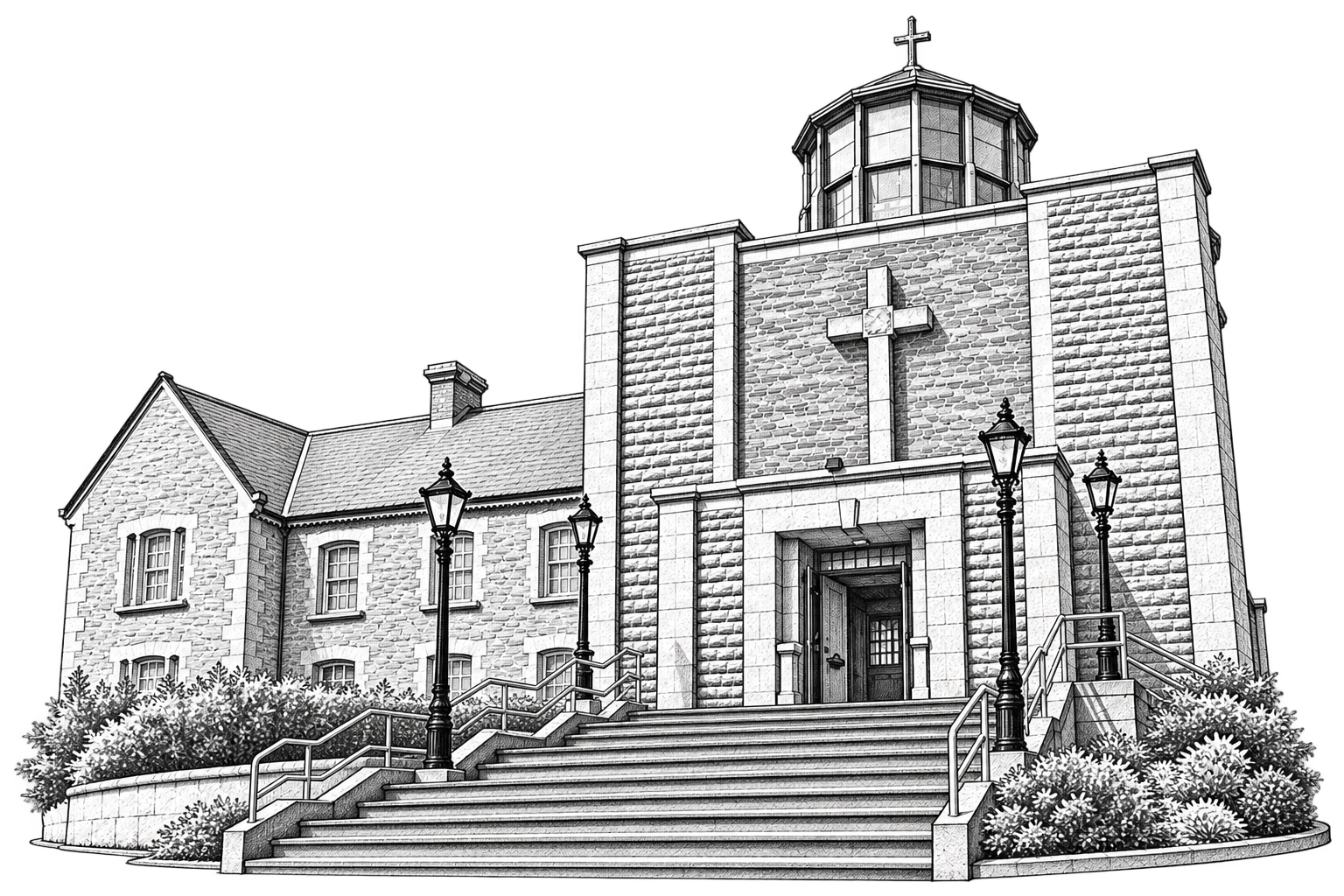
The entrance front is distinguished by rock-faced and finely dressed granite, with a large stone cross set prominently above the doorway. Architectural records associate the granite with Fanad and praise the quality of the masonry.
The twelve-sided lantern
Above the building rises an unusual twelve-sided, copper-clad roof lantern with glazed panels and a cross finial. It gives the church a distinctive silhouette on the Moville skyline.
The interior
The spacious interior includes a gallery, vaulted ceiling treatment, and marble furnishings. The church was built before the major liturgical changes associated with the Second Vatican Council, making its design a record of an important era in Catholic architecture.
Sacred treasures of St Pius X
Religious art helps to tell the Gospel story and draws worshippers into reflection and prayer.
The Passion of Christ
The church's Stations of the Cross are attributed by the National Inventory of Architectural Heritage to the artist Sheila McClean. The Stations invite prayerful meditation on Christ's journey to Calvary and remain an important part of Catholic devotion, particularly during Lent and Holy Week.
St Pius X and St Joseph
A sycamore statue of St Pius X and a carved figure of St Joseph, attributed to J. Haugh, are among the noteworthy artworks recorded within the church. They honour the saints while reflecting the skill of the craftsmen who helped furnish the building.
Altar and tabernacle
The altar is the focal point of the celebration of Mass, where Catholics gather to hear the Word of God and share in the Eucharist. The tabernacle is a place of particular reverence because the Blessed Sacrament is reserved there.
A church for everyday faith
Alongside the Sunday Eucharist, parish life includes weekday prayer, the Sacrament of Reconciliation, Eucharistic Adoration and devotions such as the Rosary and Divine Mercy Chaplet. These practices continue the rhythm of worship that has shaped generations of Catholic life.
Four places of worship, one parish family
Moville's Catholic identity is shared among the town and surrounding rural and coastal communities.
St Pius X Church
Opened in 1958, St Pius X serves as the parish's principal church. Its distinctive stone façade and roof lantern make it a landmark of Catholic life in Moville.
St Mary's Church
St Mary's represents an older chapter of parish worship. A nineteenth-century church associated with a historic graveyard, it has Gothic-influenced features and a prominent tower. A date of 1885 is associated with the present building, although an earlier chapel stood in the locality and the precise building chronology deserves further archival study.
St Columba's Church
The diocesan directory associates St Columba's with 1949. Dedicated to the great saint of Donegal and patron of the Diocese of Derry, the church reflects the commitment to keeping Catholic worship accessible to communities throughout the parish.
St Joseph's Oratory
Associated in the diocesan directory with 1947, the oratory at Shrove offers a smaller and more intimate setting for prayer and worship. Its dedication honours St Joseph, patron of families, workers and the universal Church.
For current Mass times and service arrangements, please consult the parish bulletin. Historic church dates shown here should not be used to infer the exact date of consecration without parish records.
The Sisters of Mercy in Moville
The arrival of the Sisters of Mercy transformed the educational, spiritual and charitable life of the town.
More than 130 years of service
The Convent of Mercy was founded in Moville in 1863. For generations, the sisters devoted themselves to education, care and the practical expression of Christian compassion.
Schools for boys and girls once stood behind the convent, and the convent chapel provided a centre for worship before the building of St Pius X. The sisters' work touched the lives of countless families through teaching, pastoral presence and service to those in need.
The original convent building is a notable example of nineteenth-century institutional Gothic architecture, with fine stonework and warm sandstone details. It stands alongside the church and parochial house as part of a significant historic group.
From convent to Taobh na Cille
The former convent was acquired in 2003 by North and West Housing and adapted to provide accommodation for older people. Its new name, Taobh na Cille, reflects its location beside the church.
Although its original religious use came to an end, the building continued to serve the local community in a different way — an appropriate continuation of the Mercy tradition of care and dignity.
The Sisters of Mercy's own historical account remembers both the sadness of the convent's closure and the value of its renewed community purpose.
Sacraments, family and community
The parish's history is written not only in stone, but in the lives of the people who have worshipped here.
Baptism and belonging
Through Baptism, generations of children have been welcomed into the Church. Parish baptismal records preserve a precious record of families and community life.
First Communion & Confirmation
Preparation for the sacraments connects parish, home and school. The celebration of First Holy Communion and Confirmation remains an important part of Catholic family life.
Marriage, prayer & remembrance
From weddings and anniversaries to funerals and remembrance, the parish accompanies families through moments of joy, change and sorrow, entrusting each generation to the love of God.
Parish registers and stories of the past
The documentary record offers an invaluable link with those who came before us.
Historic Catholic registers
Digitised Moville parish registers are preserved by the National Library of Ireland. The surviving nineteenth-century baptismal and marriage records provide an important starting point for family history research, particularly for descendants of people who emigrated from Inishowen.
These records preserve names, relationships and moments of family life, making them an enduring resource for parish heritage and genealogy.
Memories collected by schoolchildren
The National Folklore Collection's Schools' Collection includes work gathered at the Convent of Mercy in Moville. Its stories recall local religious customs, Confirmation ceremonies, holy places, Cooley Cross and the ruined church at Cooley.
These accounts preserve memories passed down by earlier generations. They are best read as local oral tradition, which can enrich historical research without always providing independent proof of every detail.
Our heritage continues
From the earliest monastic communities at Cooley to the worshippers who gather in Moville's churches today, the story of this parish is one of continuity and renewal. It is expressed through the celebration of Mass, the prayer of families, the work of schools, the care of neighbours and the remembrance of those who have gone before us.
Our buildings and monuments are treasured because of the faith and service they represent. They remind us that each generation receives an inheritance — and is called to pass it on with generosity, welcome and hope.
May the faith that sustained those who came before us continue to guide our parish into the future.
Historical sources & archives
The following sources underpin the historical material on this page. Traditions and uncertain dates are identified as such in the text.
- National Inventory of Architectural Heritage — St Pius X Church
- National Inventory of Architectural Heritage — former Convent of Mercy
- Congregation of the Sisters of Mercy — Mercy in Moville
- Heritage Council — Cooley Cross and Graveyard
- Ask About Ireland — Cooley Cross and Skull House
- Diocese of Derry — Moville Parish and Churches
- National Library of Ireland — Moville Catholic Parish Registers
- National Folklore Collection — Convent of Mercy, Moville